
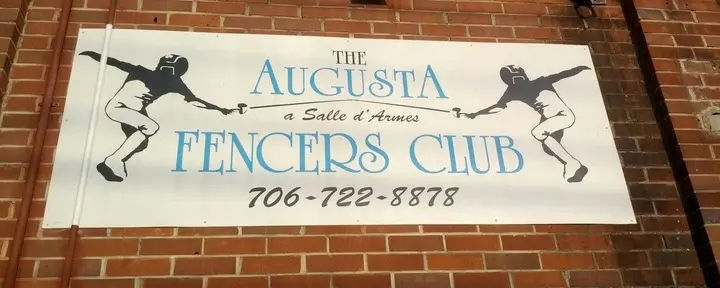
Augusta Fencers Club

Club History
Augusta has had fencing in its history as far back as the 1780s when a Charles Chevalier had a fencing and dancing school.
The present Augusta Fencers Club was in existence (and held official tournaments) at least by the early 1970ʼs when Dr. Volkmann first organized fencing in Georgia as the Chairman of the Georgia Division from his then-base in Atlanta. On moving to Augusta to chair the music department of Paine College in 1987, Club President Michael Hennessey turned the club over to Dr. Volkmann.
For the next 13 years the club met on Thursday evenings in the studios of the Augusta Ballet School for classes and lessons; official tour- naments were held in the Paine College gymnasium and at the Warren Road Recreation Center.
In 2000, Dr. Volkmann retired from his college career, renovated the second floor of the building at 134 Ninth Street in downtown Augusta, and the club began meeting five nights a week. It was then one of only two competition sites in the state specifically dedicated to fencing with permanent strips and overhead scoring equipment.
In 2013 Dr. Volkmann and Assistant Coach, Collin McCoy, formed an LLC which purchased the building now housing the club on the corner of Fifth and Greene Streets. After working for a year and half on the renovations, the club opened for business at its present site at the intersection of Fifth and Greene Streets.

Club Policies
-
Courtesy and respect for other members, guests, and the great traditions of fencing areexpected of all members.
-
All Augusta Fencers Club members must also be USFA members at some level.
-
All club members are expected to make progress towards owning their own equipment. Club members are also expected to keep their equipment clean and in good working order.
-
Members are more than welcome to find their own equipment sources. All responsibility for such equipment is the memberʼs own, though we are happy to give advice on such purchases. Equipment is also available through the club. Typically our prices are the vendorʼs catalog prices, with the club picking up the shipping charges. Special orders may be an exception. The club assumes responsibility for equipment purchased through the club.
-
Access to the armoury is included in the club dues; members are highly encouraged to use their own tools. If the shop tools are used, all such tools must be returned to their proper storage slots; safety glasses must be worn when using grinders or electrical cutting tools; personal tools and/or equipment left in the shop (except for blades left in the acetone pipes) are subject to confiscation and a storage fee/fine. Small parts are available for purchase on the honor system. The exercise equipment is available for use by all members and parents. Please use this responsibly -- children using the equipment must be supervised. Instruction in the use of the equipment is available on request.
-
Lockers are available for the storage of personal equipment for $10 per month. No personal equipment except that in the shop for repairs or in one of the rented lockers may be left in the club overnight. Lockers and their contents must be kept clean.
-
Weapon-specific classes are offered weekly; these consist of a combination of instructional exercises, partnered drills, and supervised competitive fencing. Participants are encouraged to stay after class and continue to free-fence. Any and all youth fencers are welcome to also participate in the adult class at no extra charge.
-
Private lessons are 25 minutes in length and are generally scheduled weekly in consultation with the instructor. Students are financially responsible for whatever time-slot has been arranged for.
-
Bills are posted at the beginning of each month, and are due at the first meeting of each month.
Our Coaches
Dr. V

He is the author of America’s best-selling book on fencing (Magnum Libre d’Escrime) now in its fourth edition (Edition 3.0.1, available from leading fencing equipment vendors and Amazon). His one-semester text extracted from that volume designed for college classes is in use in a number of colleges and universities throughout the country.
An early organizer of fencing in the Georgia Division, Dr. Volkmann has been an officer on the division’s executive board nearly every year since 1972; he chaired the Southeast Section (consisting of the eight divisions in the Southeast United States) for several terms before sections were disbanded by the USFA in 2004.
Dr. Rudy Volkmann, head coach, took his first fencing class in 1960; he taught his first fencing class in 1965. He has taught fencing lessons and classes almost without a break ever since.
In his other life, Dr.Volkmann still composes and performs, having retired from a thirty-year career as a music theory professor/ department chair in 2000 and opening the August Fencers Club on a full-time basis.
Dr. Volkmann’s students (in all three weapons) have included regional, national, and international medalists. He instills a love for the game in his students; former students have gone to achievements including membership on a two-time NCAA sabre championship team, a twice-second place individual NCAA foil medalist, and the founder of the Georgia Tech fencing club.
Competitively, Dr. Volkmann is a sabrist. He has won numerous Georgia Division championships, several Southeast Section championships, numerous national medals, and the Bronze Medal in the Veteran 60+ World Championships.

A National and International armourer, he was an official in the 1996 Olympic Games in Atlanta, GA; his text on weapons repair (now in its fifth edition) has been the USFA’s major reference on electrical fencing repair since its first printing in 1974. It, too, is available from major fencing equipment vendors.
Coach Sarah Bender started fencing in 1993. She quickly fell in love with the sport and was happy to help with any beginners who came into the group. She fenced with the club at University of California, Irvine. She then served as the captain of the women’s foil team at the University of Toronto while working on a Master’s degree in medieval studies. Throughout, she served as an assistant in the college fencing courses taught by her coaches.
Marriage, children, and relocations as a military spouse put Sarah’s fencing on pause for several years. She had the opportunity to train briefly with Dr. V the first time she lived in Augusta, but the Navy soon moved the family to new places. A move to Maryland and the entry of her oldest child into the sport re-kindled her desire to teach others. She was offered a coaching position at Baltimore Fencing Center. There she helped to develop and coach their youth competitive team.
Sarah is The Director of Youth Development for Augusta Fencers Club as well as coaching both the Foil and Epee Youth Competition Teams. She is thrilled to have the chance to work with the children of the club, sharing her passion for fencing with the next generation.

Coach Sarah

Coach Collin McCoy started fencing in 1996 here at the Augusta Fencers Club. Collin has been affiliated with Augusta Fencers Club for 30 years, first as a student, and now as a coach. He specializes in fencing strategy, works with our competitive teams, and does lessons for advanced Students.
In his other life, Collin is the father of 2 and owner of Adept Imaging.
Coach Collin
Augusta Fencers Club is part of the Georgia Division of the United States Fencing Association. The USFA is part of Federation Internationale d'Escrime, the international body of fencing for the world.
All tournaments can be registered on AskFred.